Biphasic DNA damage checkpoint DNA damage checkpoint signaling at DSBs Biology Diagrams A recent study used immunofluorescence (IF) staining of repair proteins as surrogate markers to examine DSBs, SSBs, and base damages in human cells to directly visualize the induction and repair of clustered DNA lesions at the single-cell level . Results showed that a large fraction of 53BP1, XRCC1, and hOGG1 foci colocalized with another In the meantime, an intimate relationship between mechanisms of damage checkpoint pathway, DNA damage repair, and genome stability was also uncovered. Reviewed herein are the recent findings on both the mechanisms of activation of checkpoint pathways and their coordination with DNA damage repair machinery as well as their effect on genomic

Keywords: Checkpoint, DNA damage, Cell cycle, Genome stability, Mitosis. While there are many lesion-specific responses for DNA repair, different lesions in genomic DNA activate common checkpoint pathways whose goal is to maintain CDKs in an inactive state until the lesion is removed. Broadly speaking, DNA damage checkpoints can be

DNA damage kinase signaling: checkpoint and repair at 30 years Biology Diagrams
ABSTRACT. Cell cycle checkpoints activated by DNA double-strand breaks (DSBs) are essential for the maintenance of the genomic integrity of proliferating cells. Following DNA damage, cells must detect the break and either transiently block cell cycle progression, to allow time for repair, or exit the cell cycle. Reversal of a DNA-damage-induced checkpoint not only requires the repair of these The signal transducers activate p53 and inactivate cyclin-dependent kinases to inhibit cell cycle progression from G1 to S (the G1/S checkpoint), DNA replication (the intra-S checkpoint), or G2 to mitosis (the G2/M checkpoint). In this review the molecular mechanisms of DNA repair and the DNA damage checkpoints in mammalian cells are analyzed. In sum, apical kinases perform highly elaborate actions in the spatiotemporal control of checkpoint responses and DNA repair. Since checkpoint functions and early resection blockades can counteract HR‐mediated DNA repair mechanisms, the ability of cells to modulate DNA damage signaling is essential for repair pathway control, and, in
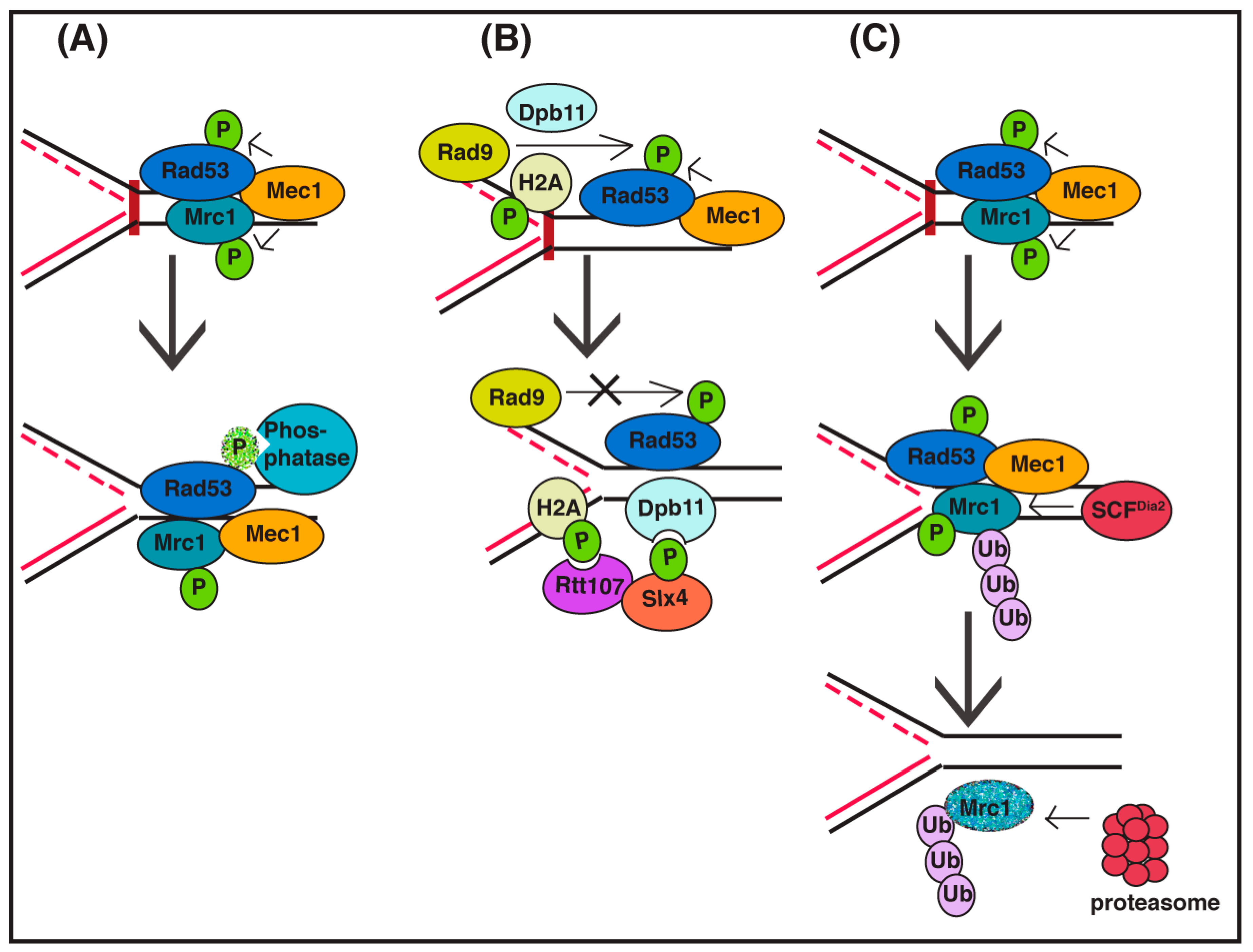
The integrity of genomic DNA is continually monitored and DNA repair is coordinated with the cell cycle via the G1/S, intra-S phase, and G2/M checkpoints. During mitosis, communication between the mitotic checkpoint complex (MCC) and anaphase-promoting complex/cyclosome (APC/C) ensures the proper alignment and segregation of chromosomes. The repair of DNA lesions that occur endogenously or in response to diverse genotoxic stresses is indispensable for genome integrity. DNA lesions activate checkpoint pathways that regulate The damaged DNA may activate the DNA damage response signaling pathway, where DNA damage checkpoints play a central role in arresting the cell cycle and mediating the DNA repair process. The unsuccessful repairing of DNA lesions may cause apoptosis, cell death or cancer.